completed Assessment
Virtual Solutions for Chronic Kidney Disease Management
Assessment Released
Last Updated
September 9, 2026
Conditions
Chronic Kidney Disease
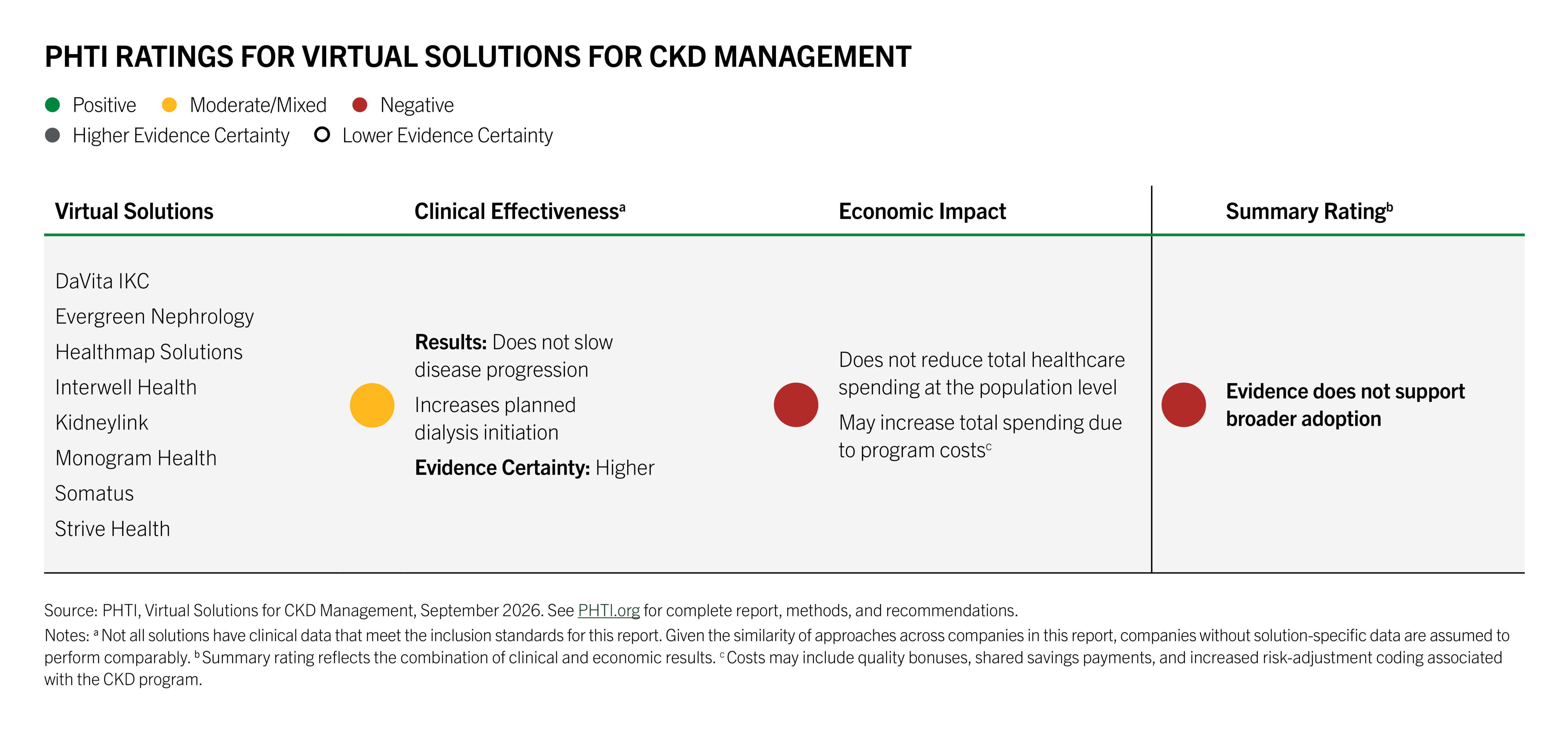
PHTI's assessment finds virtual solutions for CKD management do not slow disease progression or reduce healthcare spending.
Area overview
Chronic kidney disease (CKD) affects one in seven U.S. adults—37 million people—yet 87% are unaware they have the condition. Traditional Medicare alone spends $141 billion annually on patients with CKD, and employers spend approximately $107 billion, plus $30 billion in indirect costs.
Companies that offer virtual solutions for CKD management assume financial responsibility for the total cost of care of patients with diagnosed CKD stages 3–5 and engage both nephrology practices and patients directly. Practice-facing services include financial and contracting support, as well as risk sharing that enables nephrologists to participate in value-based arrangements. They also equip practices with data and analytics to identify high-risk patients and gaps in care. Companies often employ their own care coordination teams to support patients and offer educational resources related to medications, kidney failure treatment, and other relevant content to patients.
Download the evaluation

Virtual Solutions for Chronic Kidney Disease Management
Released September 9, 2026
September 9, 2026
Executive SummarySeptember 9, 2026
Patient GuideSeptember 9, 2026
Overview for PolicymakersSeptember 9, 2026
AppendicesSeptember 9, 2026
Data SupplementReport contributors and reviewers provided important expertise and insight throughout our process. Those who directly contributed to the report have no relevant conflicts of interest to disclose.
Summary of findings
PHTI’s assessment found that virtual CKD solutions lack evidence of broad clinical or economic benefit, despite delivering modest improvements in planned transitions to dialysis.
Specifically, virtual CKD management solutions:
- Do not slow disease progression. Virtual solutions for CKD management show no consistent evidence of slowing disease progression—either by improving guideline-recommended medication use proven to slow kidney damage or by slowing the rate of kidney function decline—compared with usual care.
- Do not lower total healthcare spending. The limited clinical impacts of these solutions do not result in meaningful reductions in healthcare spending. For a million-member Medicare Advantage plan, these CKD companies are responsible for more than $5 billion in annual healthcare spending and reduce that spending by only 0.1%.
- Improve transitions to dialysis for a small number of patients. Evidence suggests that virtual CKD management solutions result in higher rates of patients beginning dialysis in a planned, outpatient setting rather than “crashing” into dialysis, which can lead to complications and increased spending. But for every patient they manage, only about 1 in 1,000 benefits from increased rates of planned dialysis starts.
Webinar
Guidance & considerations for stakeholders
- Tie population-based performance payments to real cost reductions. Purchasers should structure shared savings arrangements to direct a greater share of payments toward utilization-based cost reductions, and should consider additional incentives for absolute cost reductions rather than reductions relative to a growing benchmark. While planned dialysis starts remain a relevant performance milestone, they should not solely determine contract success given the small subset of the CKD population impacted.
- Prioritize early patient identification and guideline-recommended medications. Purchaser contracts and company offerings should be oriented around intervening earlier in CKD disease progression. Solutions should ensure lab testing is completed, support accurate diagnosis and staging, and help providers—including PCPs—initiate guideline-recommended medication therapy as early as possible.
- Advance evidence generation. The peer-reviewed evidence base supporting these solutions’ effects on disease progression, cost reduction, patient engagement, planned starts, and other process measures associated with effective CKD management is limited. Companies should invest in rigorous, comparative research to strengthen the evidence available to purchasers.
- Shift future models toward upstream care while emphasizing guideline-recommended medications in existing programs. Future kidney models should shift incentives toward earlier CKD stages. CMS should consider adding CKD medication prescribing and adherence measures to Traditional Medicare incentive programs and medication-related reporting to Medicare Advantage quality ratings. CMS should also consider adding medication use measures to the cardio-kidney-metabolic tracks in its ACCESS model, as adherence to these medications is directly linked to slowing disease progression.
Why assess virtual solutions for CKD management?
- CKD affects one in seven U.S. adults—37 million people—yet 87% are unaware they have the condition.
CKD prevalence increases with age but approximately half of patients (51%) are younger than 65. CKD is more common among Black adults (22%) and Asian adults (16%) than among white adults (13%). - Traditional Medicare alone spends $141 billion annually on patients with CKD, plus an unknown amount of spending for CKD patients enrolled in Medicare Advantage. Employers spend approximately $107 billion, plus an additional $30 billion in indirect costs due to absenteeism and lost productivity.
- Spending increases substantially once patients progress to end-stage kidney disease (ESKD). In 2023, patients receiving dialysis or a kidney transplant accounted for $24.4 billion in Traditional Medicare spending.
- Avoiding progression to end-stage kidney disease (ESKD) is critical, yet remains challenging—an opportunity that has prompted widespread investment in companies offering virtual CKD management solutions.
- Enrollment in CKD management solutions has grown rapidly, driven by increased contracting by Medicare Advantage plans and participation in the Kidney Care Choices (KCC) model in Traditional Medicare.
- Providers, patients, payers, and employers want to understand the impact of virtual solutions on CKD management.
- Health plans, including Traditional Medicare and Medicare Advantage, need evidence on which contracting approaches and performance measures help slow disease progression and reduce long-term spending.
Additional Resources
October 2025
A systematic literature review of virtual solutions for chronic kidney diseaseInternational prospective register of systematic reviews (PROSPERO), National Institute for Health and Care Research
Contact
Get in touch with us if you want to learn more about opportunities to provide input on this assessment.
Read an overview of our assessment Approach and Framework
View assessment frameworkStay up to date
Sign up to receive updates.