Announcement
New PHTI Report Provides Roadmap to Scale High-Value AI in Healthcare
NEW YORK — The Peterson Health Technology Institute (PHTI) today released “Driving Adoption of High-Value AI in Healthcare,” a report that identifies the next steps for scaling high-value artificial intelligence (AI) in healthcare, focused on four domains—evidence, coverage, payment, and care delivery.
The report highlights that AI is fundamentally different from prior health technologies because it can perform work that previously required human labor and expertise, with the potential to expand the health system’s capacity to reach undertreated patients. The report also identifies certain barriers to widespread adoption built into the current healthcare system: licensure and liability rules do not contemplate care delivered by AI with limited clinician involvement; coverage policies do not define when AI-delivered care is covered; and current payment models reward activity rather than outcomes, steering AI adoption toward administrative tools that are already driving up spending rather than toward high-value clinical tools. As a result, clinical AI applications with the greatest potential to improve access and outcomes need improved pathways to widespread deployment.
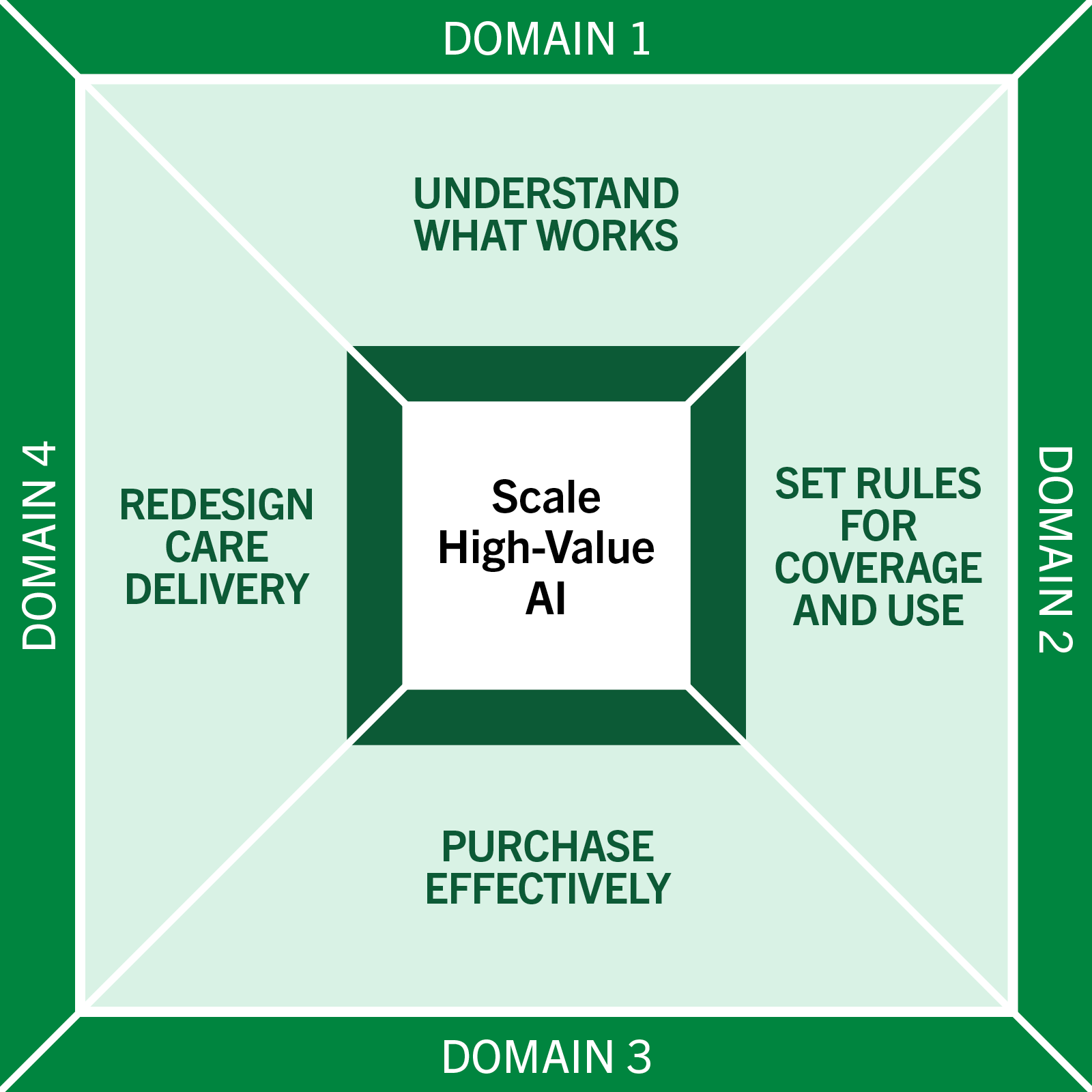
The impact and pace of AI implementation will depend significantly on the incentives and conditions that guide its adoption. PHTI’s roadmap identifies the four domains in which improvements are needed to scale high-value AI and ensure it delivers on its promise to improve health outcomes, expand access, and lower spending:
- Understand what works. Providers, payers, regulators, and digital health companies must generate real-world evidence, monitor ongoing performance, and assess outcomes. This work would build patient, provider, and purchaser confidence in AI-based care.
- Set rules for coverage and use. Policymakers and professional societies need to update licensure and scope of practice to accommodate care delivered by AI with limited clinician involvement. They must also clarify medical liability and insurance and define coverage across payers.
- Purchase effectively. Payers, purchasers, and policymakers must design new payment models, advance outcomes-based payment, and evaluate vendors against established outcome measures.
- Redesign care delivery. Health systems and providers must redesign care delivery models to incorporate clinical AI, evolve clinical workforce roles and responsibilities, and eliminate adverse administrative processes.
“If thoughtfully deployed, clinical AI tools can close existing care gaps, extend services beyond in-person care, and improve efficiency throughout the system,” said Caroline Pearson, executive director of PHTI. “While this technology has the potential to improve patients’ health, make care more accessible and convenient, and increase affordability, we don’t currently have the systems in place to achieve that vision. We need to develop broadscale changes that enable high-value AI solutions to enter the market and to ensure that the impact and savings they produce benefit patients and families.”
The report recommends that near-term efforts focus on clinical AI for conditions that are access-constrained and have measurable outcomes, such as hypertension, or depression and anxiety. The report also identifies payment as a particularly important step—it shapes where investment flows, how evidence is generated, and which technologies scale. Establishing outcome-based payment models for AI-enabled chronic care should be an early priority.
The findings are based on a series of three PHTI workshops, along with supplemental interviews with experts across the field, including leaders from health systems, medical societies, health plans, technology companies, academia, investment firms, patient groups, and federal government agencies. The report builds on PHTI’s prior workshop reports on clinical AI, administrative AI, and payment for clinical AI.
PHTI’s new report is available here.
###
About the Peterson Health Technology Institute
The Peterson Health Technology Institute (PHTI) provides independent evaluations of innovative healthcare technologies to improve health and lower costs. Through its rigorous, evidence-based research, PHTI analyzes the clinical benefits and economic impact of digital health solutions. These evaluations inform decisions for providers, patients, payers, and investors, accelerating the adoption of high-value technology in healthcare. PHTI was founded in 2023 by the Peterson Center on Healthcare. For more information, please visit PHTI.org