


Summary
AI is fundamentally different from prior health technologies because it can autonomously perform work that previously required human labor and expertise, with the potential to expanding the health system’s capacity to reach undertreated patients.
- Under current incentives, administrative AI entrenches inefficient workflows and drives inflationary billing, rather than eliminating waste.
- AI has the potential to meaningfully improve clinical care, yet adoption remains limited by the current payment, purchasing, and policy environment.
- Payment reform can accelerate adoption of high-value clinical AI. Outcome-based payment is an important starting point.
Key Takeaways
Based on discussions during a series of workshops held across 2025 and 2026, as well as supplemental interviews with experts across the field, this report sets out PHTI’s recommendations to accelerate the adoption of high-value AI in healthcare that improves health outcomes, expands access to care, and lowers spending.
The roadmap is organized around four domains, each of which must advance to build an enabling environment for high-value AI adoption:
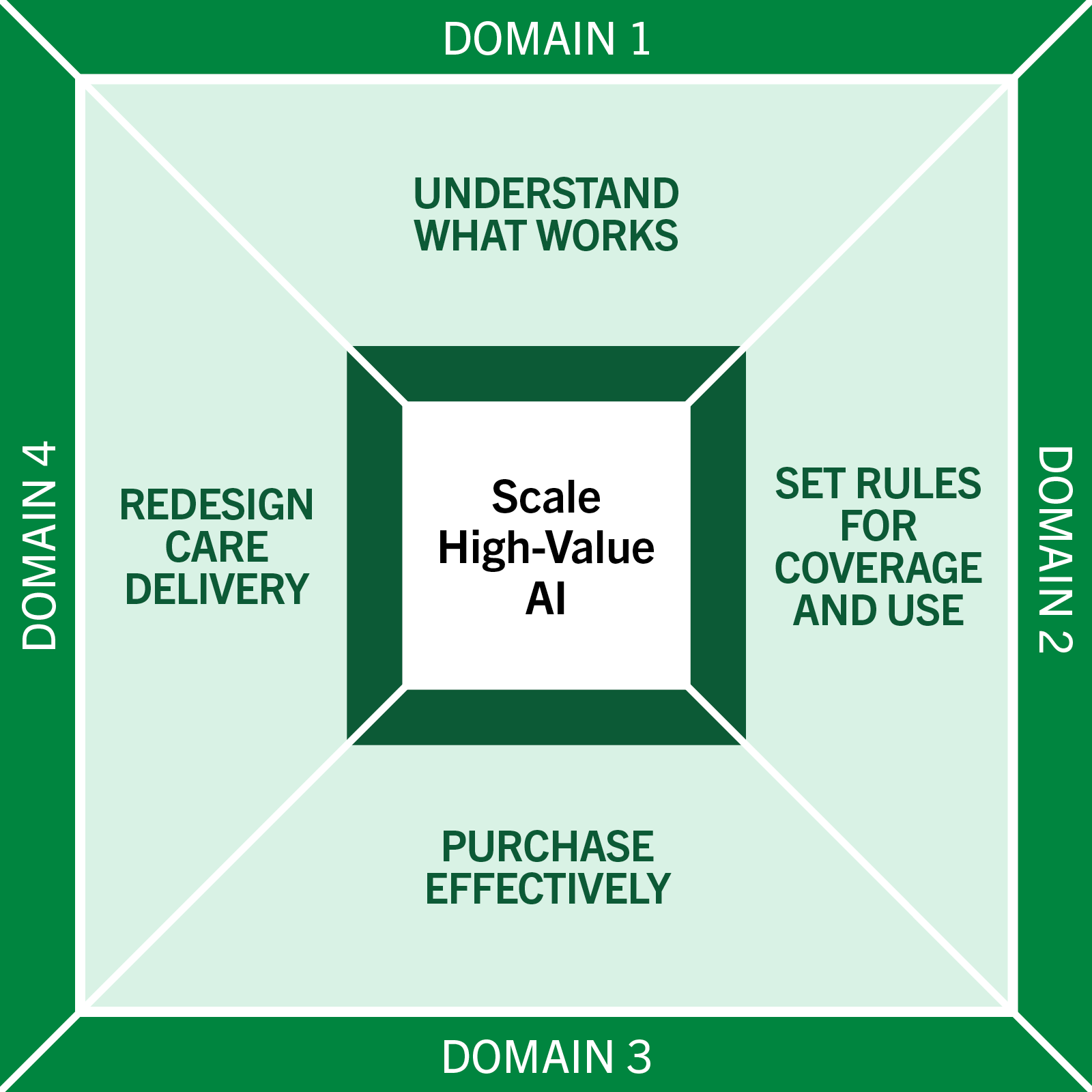

Understand what works
Providers, payers, regulators, and digital health companies must generate real-world evidence, monitor ongoing performance, and assess clinical and economic outcomes. This work would build patient, provider, and purchaser confidence in AI-based care.

Set rules for coverage and use
Policymakers and professional societies need to update licensure and scope of practice to accommodate care delivered by AI with limited clinician involvement. They must also clarify medical liability and insurance and define coverage across payers.

Purchase effectively
Payers, purchasers, and policymakers must design new payment models, advance outcomes-based payment, and evaluate vendors against established outcome measures.

Redesign care delivery
Health systems and providers must redesign care delivery models to incorporate clinical AI, evolve clinical workforce roles and responsibilities, and eliminate adverse administrative processes.
FAQs
Clinical AI is defined as AI technologies that assist or perform activities related to the screening, diagnosis, treatment, or management of health conditions.
Administrative AI is defined as AI technologies that assist or perform operational and administrative functions. In this report, administrative AI focuses on transactional activities associated with payment, including prior authorization, coding, and billing.
High-value AI in healthcare is defined as AI that measurably improves health outcomes, expands access to care, and lowers spending.
AI Applications in Healthcare
PHTI convened a three-part workshop series in Washington, D.C., bringing together senior leaders from health systems, health plans, technology developers, academia, investment firms, and federal agencies to explore pathways for responsible AI adoption across healthcare.