Industry Insight
Achieving AI’s Promise for Health Outcomes, Access, and Affordability
October 14, 2026
Caroline Pearson
As the busy mother of two school-aged kids, I know how stressful it is to not be able to get them the care they need quickly and reliably. There are monthly struggles with medication refills, not knowing whether they need to see a doctor after office hours, or finding high-quality clinical care for more complex conditions. Even as a healthcare expert, I regularly bump up against the failures of our system. For families across the country, especially those in rural and underserved communities, today’s healthcare is too often hard to navigate, slow to access, infuriatingly opaque, and prohibitively expensive. There simply isn’t enough clinician attention to go around, and this is part of why costs keep climbing and why people who need care don’t get it.
This report, which calls for accelerated development and deployment of clinical applications of AI, comes from a sober perspective: the road ahead will take a lot of work to get right, and we can’t afford not to try. We will take safety seriously. We will monitor performance and impact along the way. And we will remain attuned to real concerns from patients and clinicians.
But let us be clear: If AI can improve even a fraction of today’s healthcare challenges, we have to do the hard work to realize its potential. Not out of a cavalier belief in the power of technology, but out of the urgent need to deliver better, more accessible and affordable care to our families.
Take one example: high blood pressure. Four out of five people diagnosed with hypertension are not in blood pressure control. Most of those people see a doctor regularly, and we have low-cost medications that are effective at treating hypertension.
Yet, amidst many other demands on a primary care doctor’s time, too often high blood pressure is not the top priority in a given visit. But what if AI-enabled technology could monitor and manage blood pressure between visits—getting more patients into control and leaving time for doctors to focus on other issues?
AI already assists clinicians with existing tasks, including clinical decision support, documentation, and billing. Increasingly, it can take on aspects of direct care delivery, such as screening and diagnosis, remote monitoring, and medication prescribing. That means patients can receive care between visits, and clinicians can focus on the more complex cases that demand their expertise and attention.
In considering whether to adopt AI in clinical care, we cannot compare its impact against some idealized, always-available physician with endless knowledge and patience. We need to ask whether the solution can improve outcomes in the real world that exists today. For too many patients, their reality is low-quality care, delayed care, or no care at all—due to cost, access, or both. Measured against that reality, AI-enabled care can offer real benefits if it is well tested, carefully deployed and overseen, and appropriately reimbursed.
Today, the clinical applications of AI with the greatest potential to expand access are stalled while administrative billing and documentation tools are proliferating and being used to drive up healthcare costs without improving health outcomes. On our current trajectory, AI is set to exacerbate existing system failures.
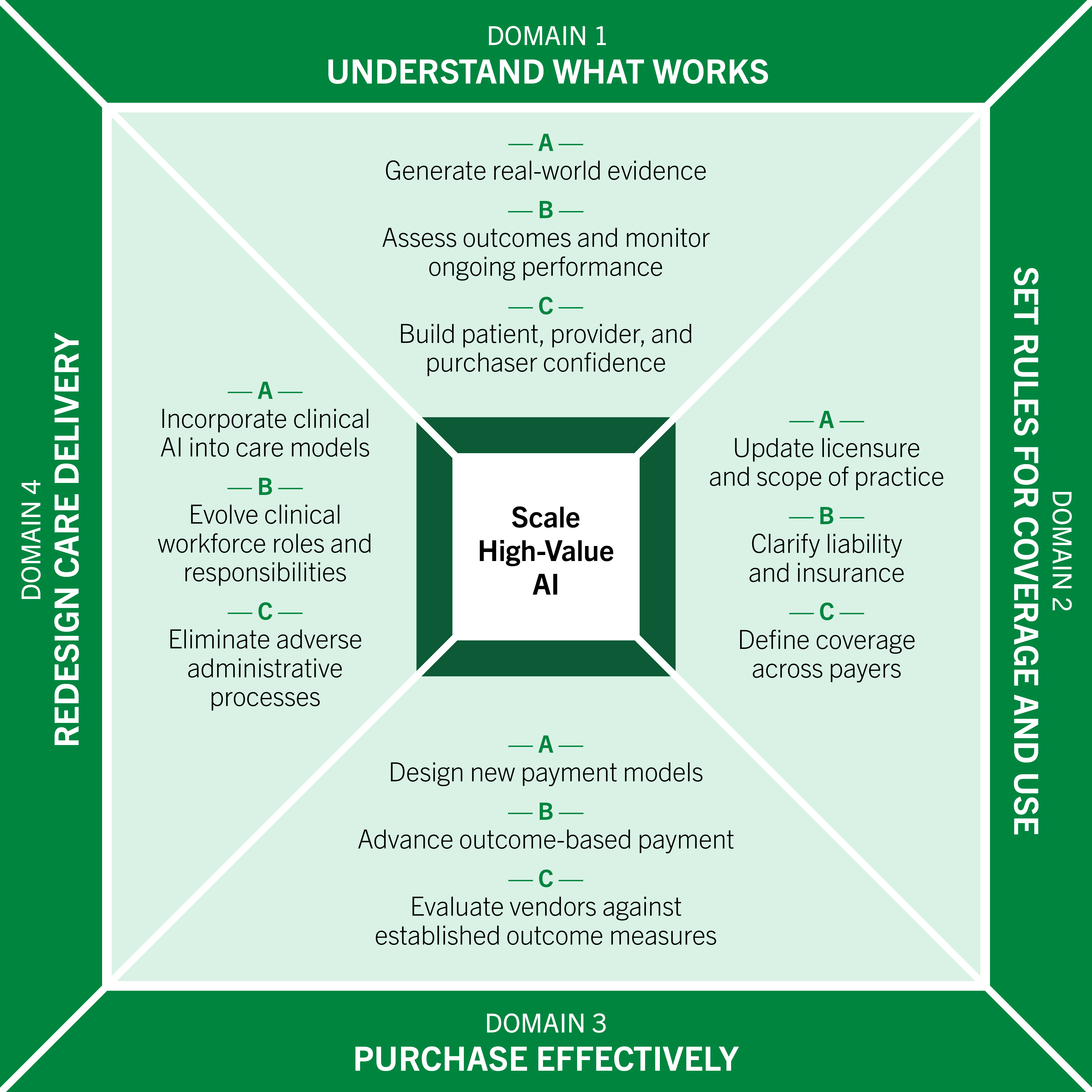
If, instead, AI is going to play a role in solving healthcare’s most intractable problems, we need a deliberate and concerted effort to build the right incentives, guardrails, and delivery models. This demands a focused effort across four domains:
- Generate better evidence about what works;
- Enable coverage for AI tools that deliver care with limited clinician involvement by updating licensure and liability rules;
- Build payment models that reward outcomes rather than activity; and
- Redesign workflows and train the workforce to use AI effectively in care delivery.
PHTI will continue to advance these aims through partnership, research, and dialogue. Others in the sector must take action and lead where they have expertise and authority: policymakers need to modernize regulatory oversight and licensure to ensure safety and enable the use of effective solutions; health systems and providers will need to redesign care delivery models and support their workforce through this transition; and health technology companies and investors must build the evidence that proves what works.
AI offers us an opportunity to build the healthcare system that works for patients—affordable care that is accessible when we need it. This roadmap lays out the necessary steps that can make it a reality.